Maple Juris
Blog

Build or buy the citation check

The first version of a citation check is a short project. Keeping it current is the part that never finishes - and the cost is senior engineers maintaining ingestion instead of your product.
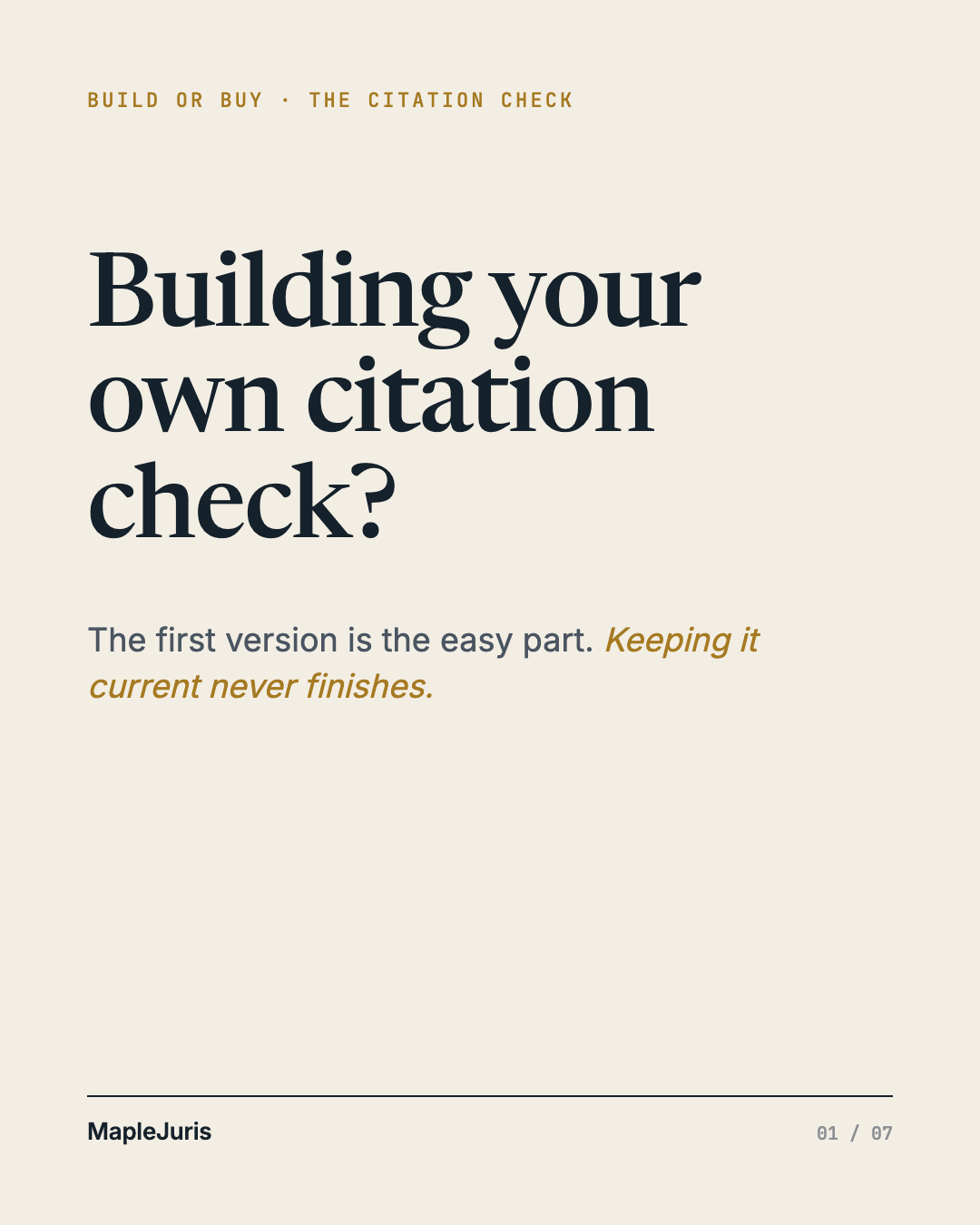
Slide 1 of 7, “Building your own citation check?” Below: “The first version is the easy part. Keeping it current never finishes.”
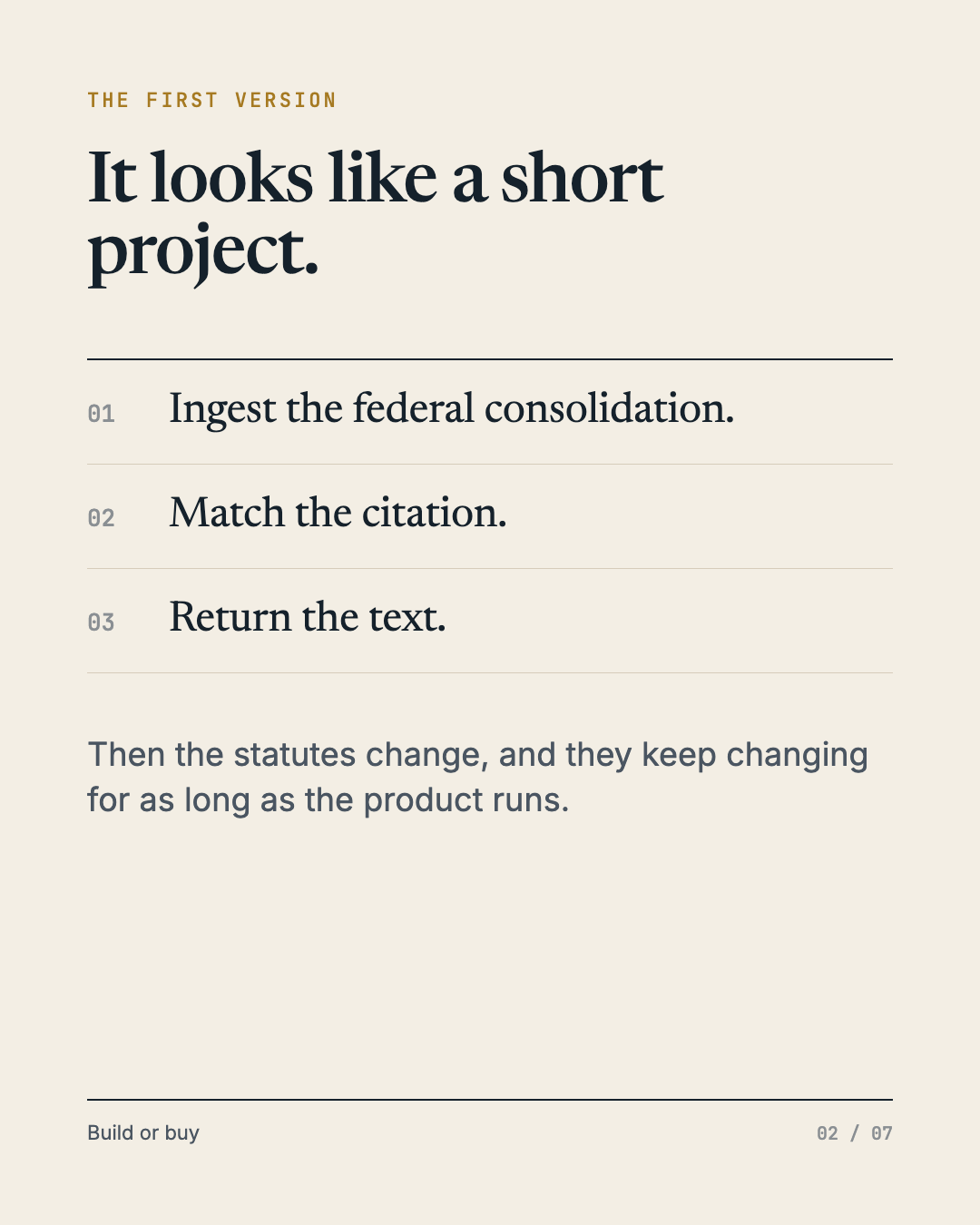
Slide 2 of 7, eyebrow “The first version”, heading “It looks like a short project.” A numbered list: 01 Ingest the federal consolidation. 02 Match the citation. 03 Return the text. Below: “Then the statutes change, and they keep changing for as long as the product runs.”
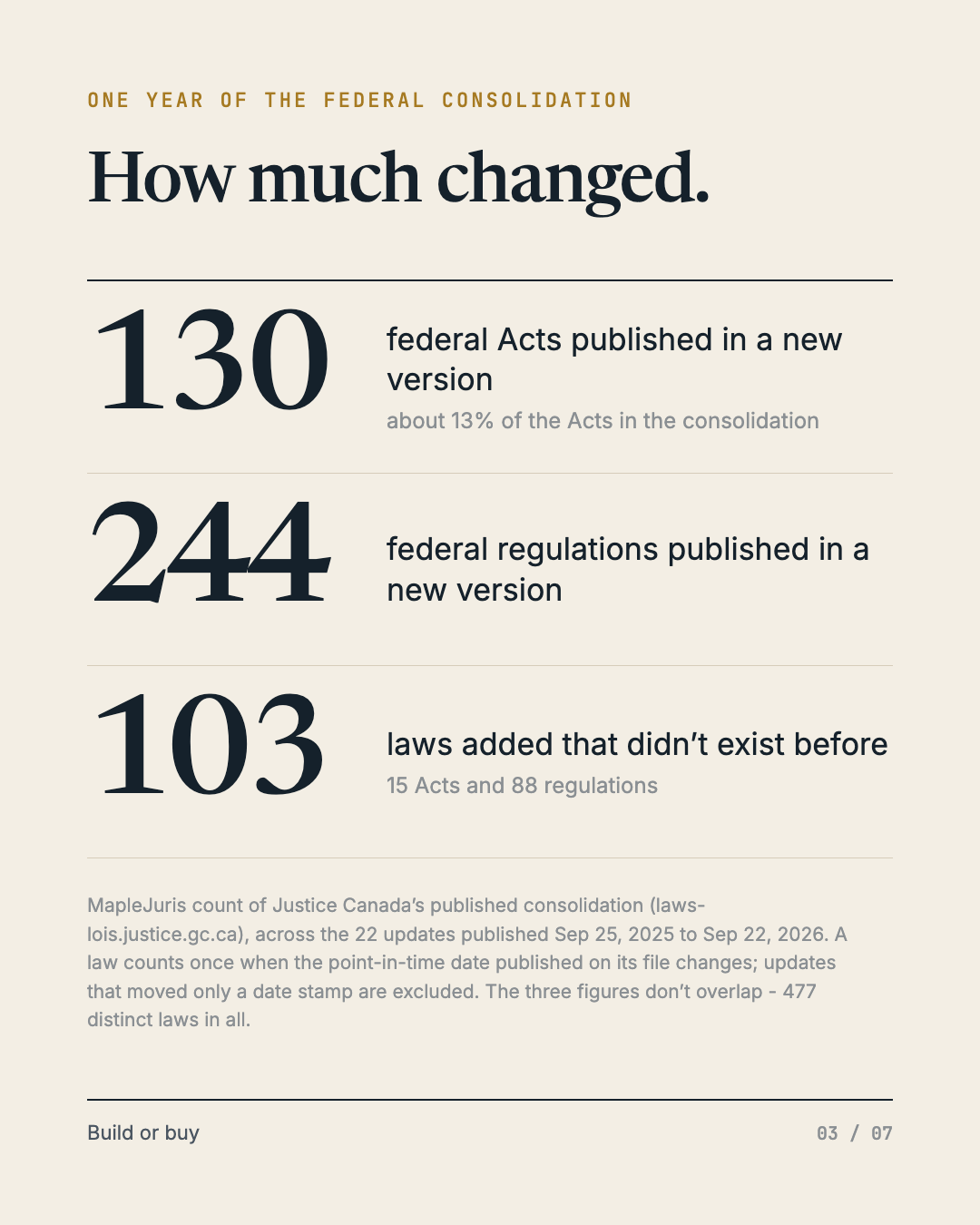
Slide 3 of 7, eyebrow “One year of the federal consolidation”, heading “How much changed.” Three figures: 130 federal Acts published in a new version, about 13% of the Acts in the consolidation; 244 federal regulations published in a new version; 103 laws added that didn’t exist before, being 15 Acts and 88 regulations. Footnote: MapleJuris count of Justice Canada’s published consolidation at laws-lois.justice.gc.ca, across the 22 updates published Sep 25, 2025 to Sep 22, 2026. A law counts once when the point-in-time date published on its file changes; updates that moved only a date stamp are excluded. The three figures don’t overlap - 477 distinct laws in all.
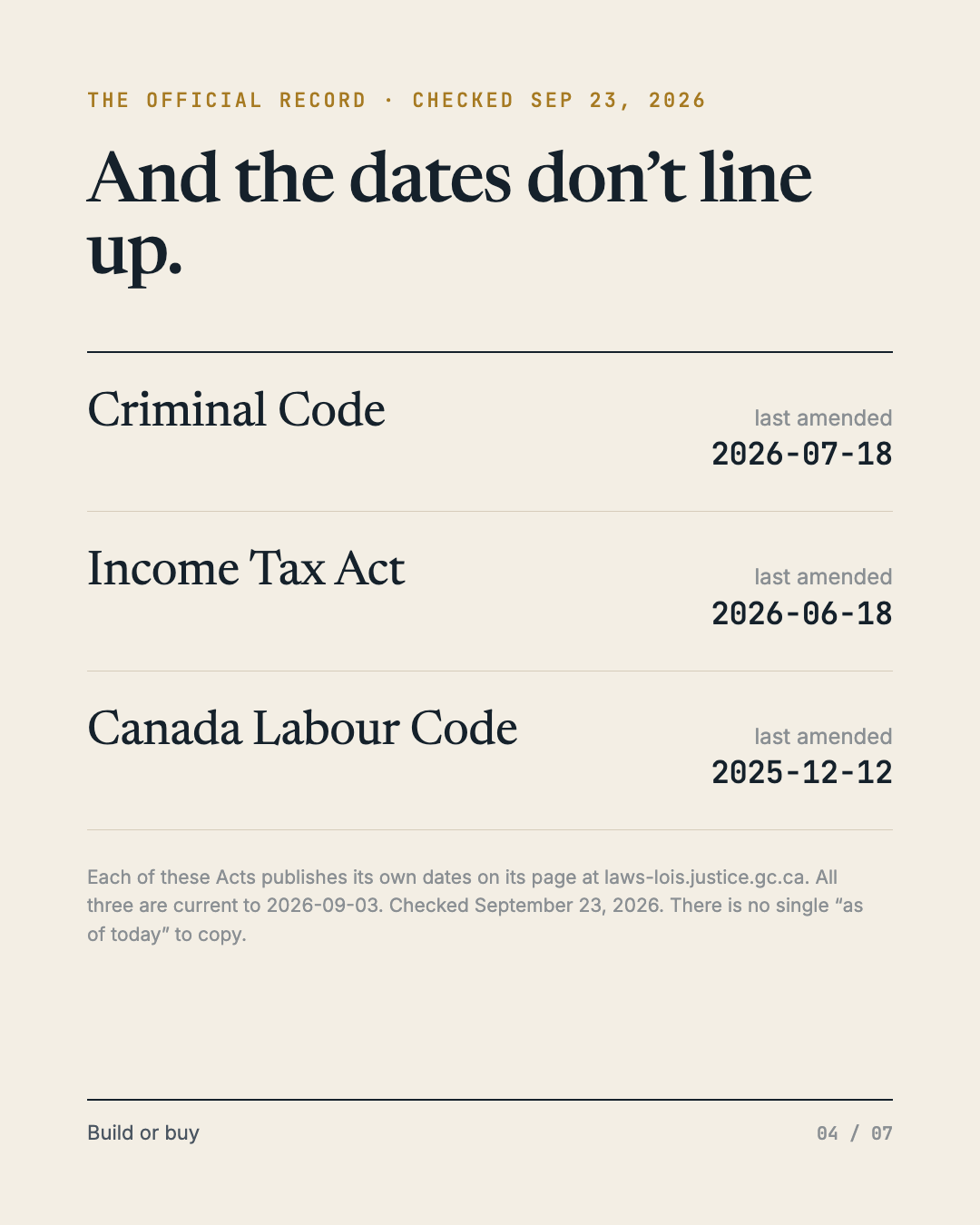
Slide 4 of 7, eyebrow “The official record, checked Sep 23, 2026”, heading “And the dates don’t line up.” A table of last-amended dates: Criminal Code 2026-07-18, Income Tax Act 2026-06-18, Canada Labour Code 2025-12-12. Footnote: each of these Acts publishes its own dates on its page at laws-lois.justice.gc.ca; all three are current to 2026-09-03; checked September 23, 2026. There is no single “as of today” to copy.
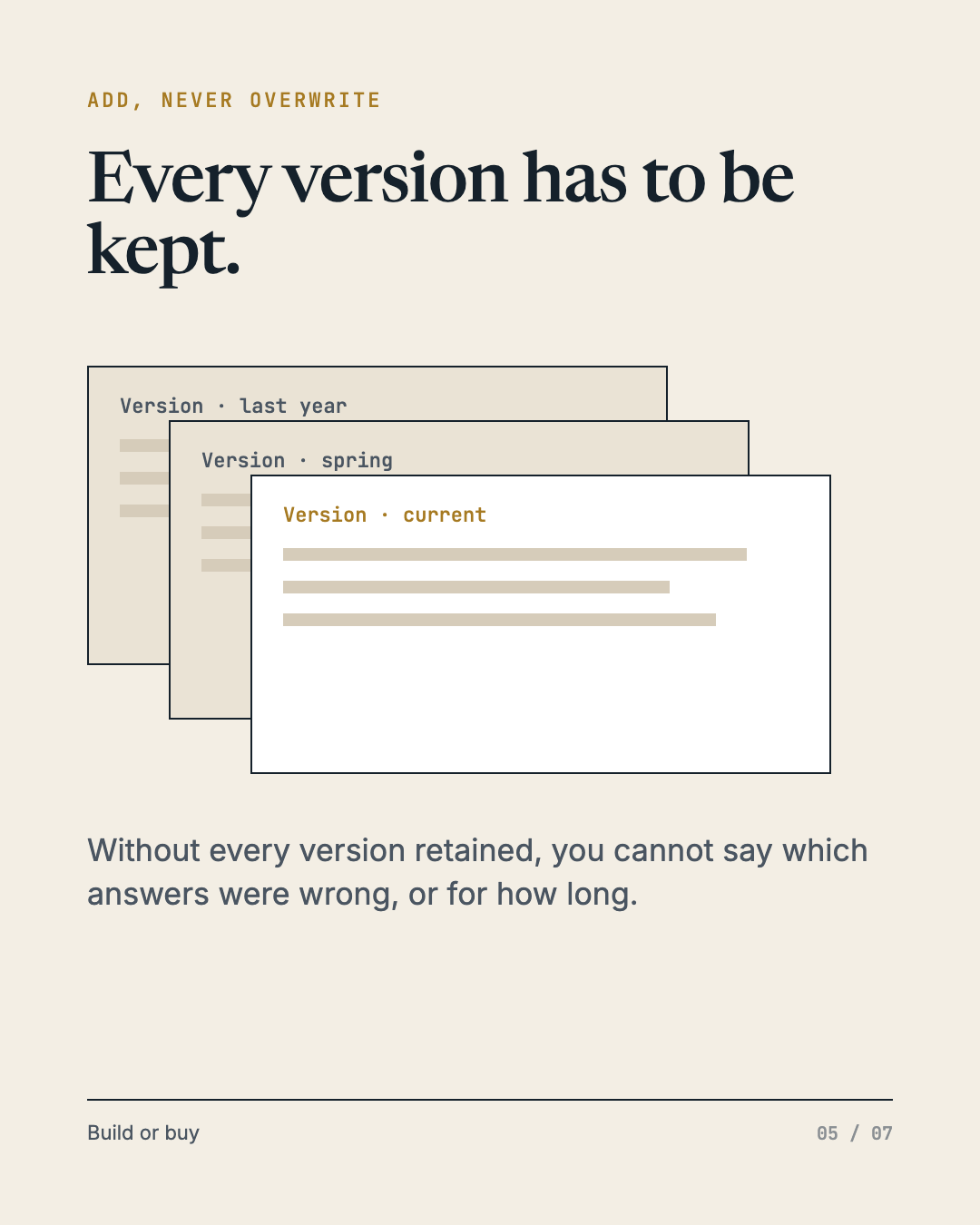
Slide 5 of 7, eyebrow “Add, never overwrite”, heading “Every version has to be kept.” Three stacked document cards labelled Version · last year, Version · spring, and Version · current, the current one in front. Below: “Without every version retained, you cannot say which answers were wrong, or for how long.”
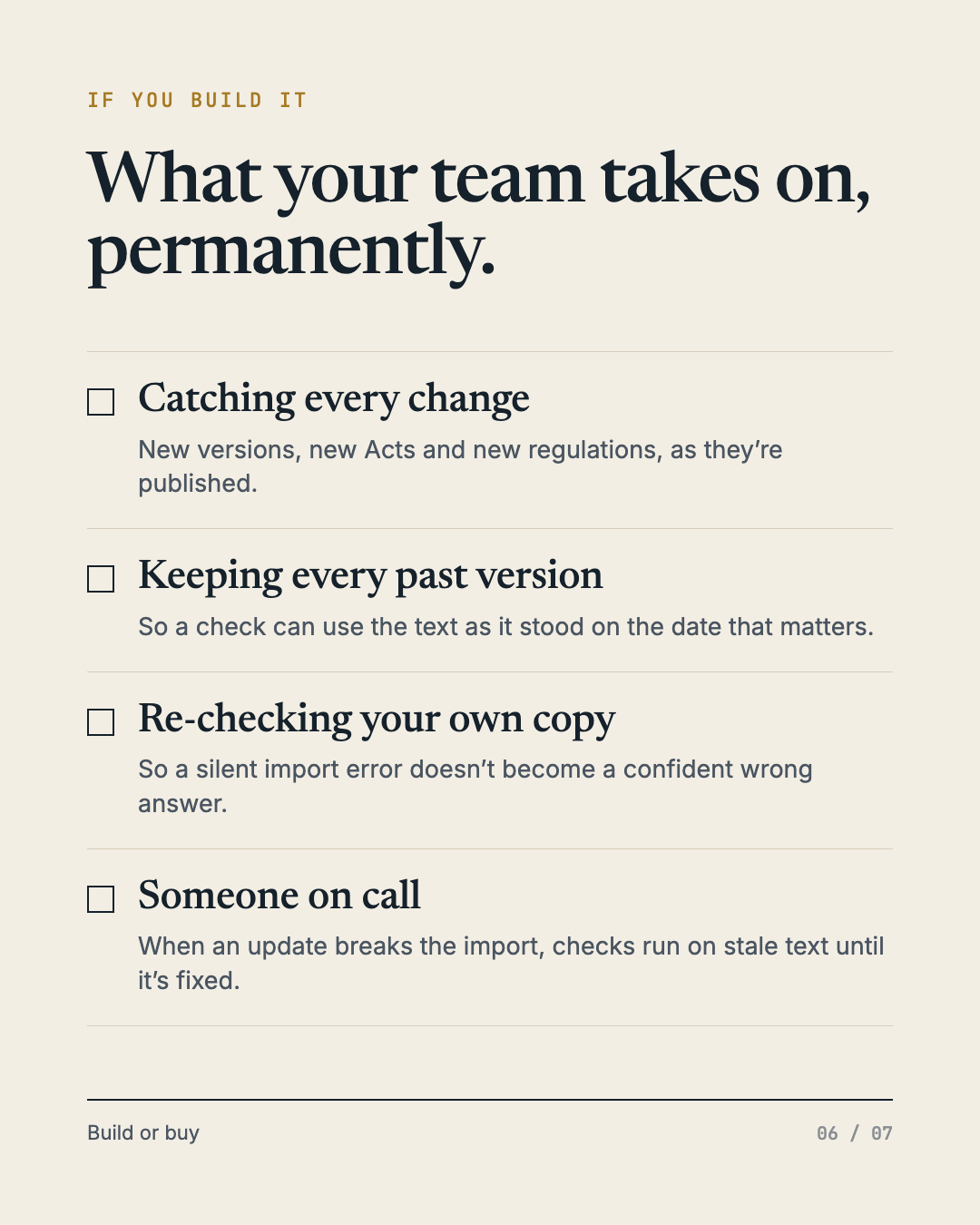
Slide 6 of 7, eyebrow “If you build it”, heading “What your team takes on, permanently.” A checklist of four unticked items: Catching every change - new versions, new Acts and new regulations, as they’re published. Keeping every past version - so a check can use the text as it stood on the date that matters. Re-checking your own copy - so a silent import error doesn’t become a confident wrong answer. Someone on call - when an update breaks the import, checks run on stale text until it’s fixed.
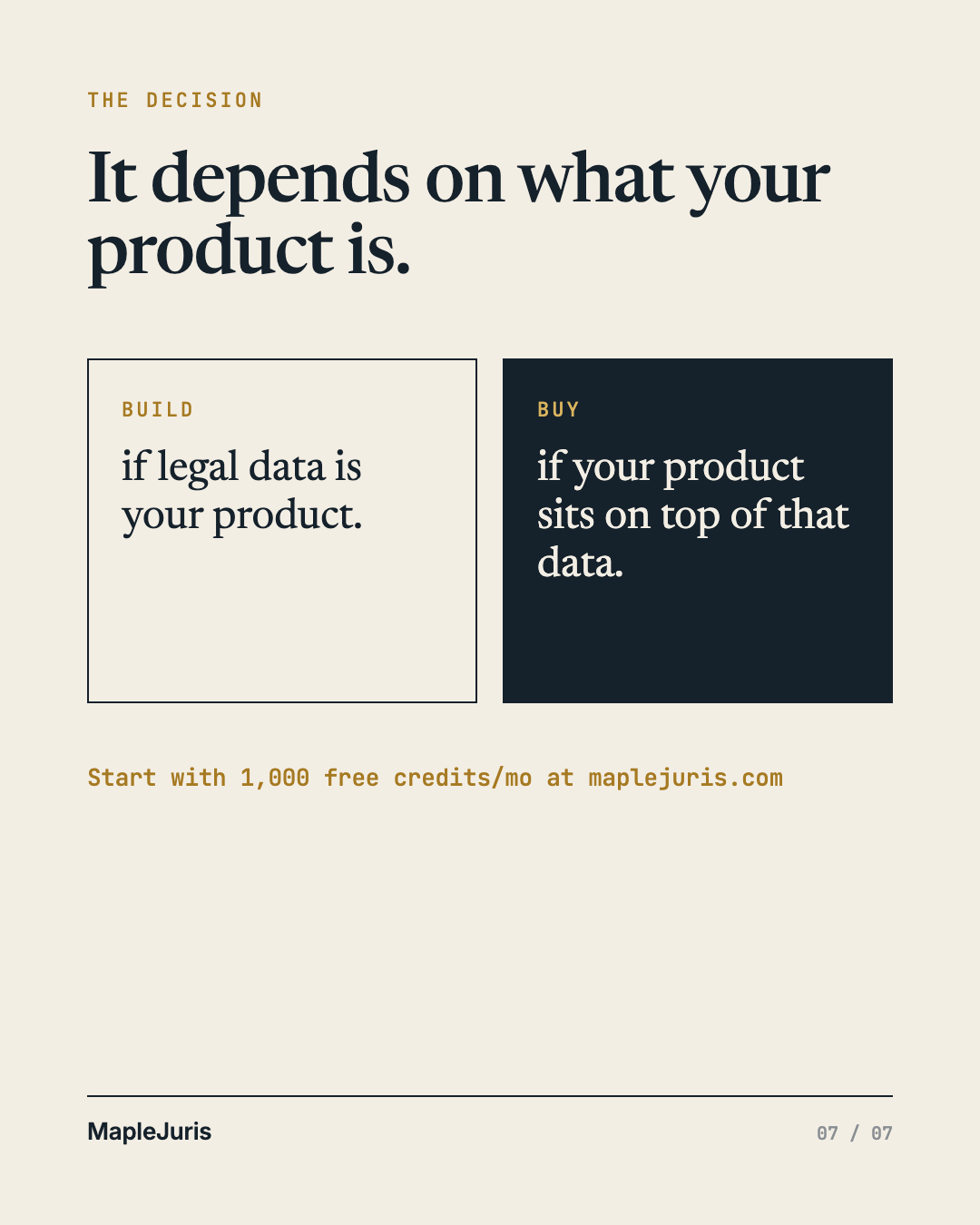
Slide 7 of 7, eyebrow “The decision”, heading “It depends on what your product is.” Two panels side by side: BUILD, if legal data is your product; BUY, if your product sits on top of that data. Below: “Start with 1,000 free credits/mo at maplejuris.com”.
1 / 7

Every legal team faces the same decision at some point: build the citation check, or buy it?

In the past year, Justice Canada published new versions of 130 federal Acts, 244 federal regulations, and added 103 laws that didn’t exist before. The Criminal Code alone appeared in five new versions.

Each new version has to be synced with every version before it - work that makes a developer look like a bookkeeper over time.

Two years of research went into our product, and our findings weren’t what we expected. Building it was never the constraint, reasoning across every single version at a single point in time was - and that’s much closer to architecture than it is to coding.

A queue of new laws arrives every few weeks, permanently. Nothing breaks loudly if it’s neglected. In fact, most systems continue to silently check and answer confidently even though the last version has already been replaced. If a legal professional uses one of those answers, without correct versioning, that case was over before it started.

The carousel above puts a year of that queue into perspective, and keep in mind, that’s just at the federal level.

The real cost isn’t the build. It’s senior engineers maintaining ingestion instead of working on your core product, and being on-call for a system that isn’t your differentiator.

The takeaway: if the legal data itself is your product, build it. If your product sits on top of it, buying usually returns more than paying to keep up with the law, technology, and a team managing both.

That’s what MapleJuris focuses on. The modelling is done, the queue is managed, and every resolved citation comes back traceable to the official source it was checked against.

Start your free evaluation today with 1,000 credits per month, no credit card required, or have our engineers integrate it into your stack - see plans and pricing.


The figures above are our own count of Justice Canada’s published consolidation at laws-lois.justice.gc.ca, across the 22 updates published between 25 September 2025 and 22 September 2026. A law counts once when the point-in-time date published on its file changes; updates that moved only a date stamp are excluded. The three figures don’t overlap: 477 distinct laws in all.