
“Is this citation real?” is the easy question
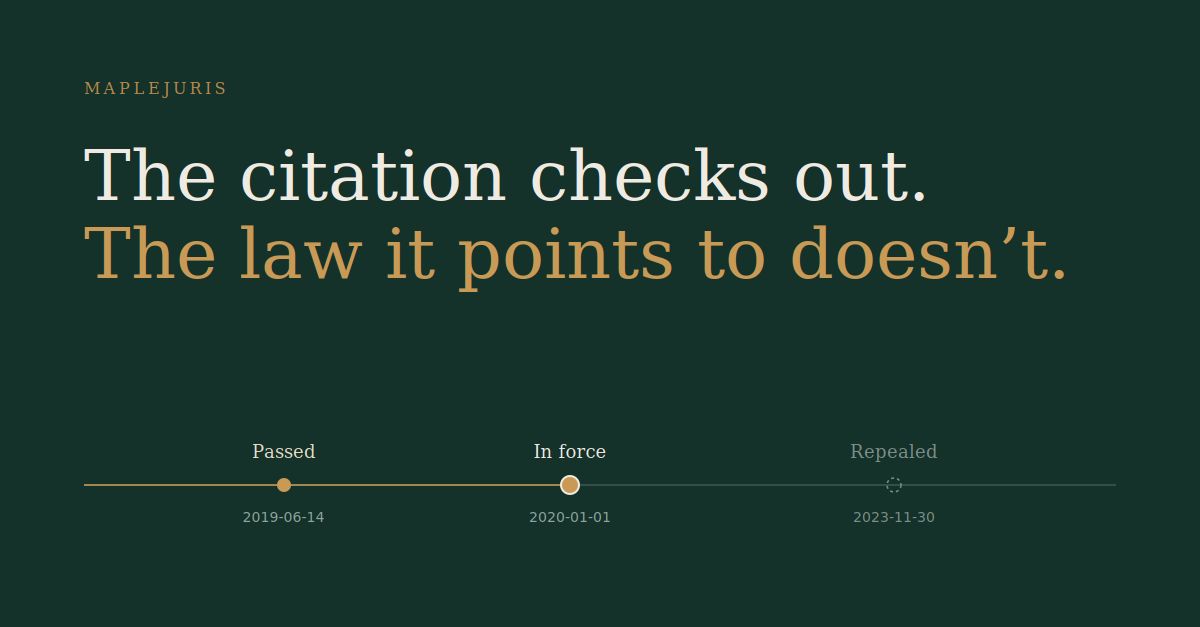
A citation can stay valid while the law underneath it changes. The harder question is whether it was real on the date that matters.
Edited to state current coverage: federal and Ontario acts and regulations.
"Is this citation real?" is the easy question.
"Was it real on the date that matters?" - that’s the harder one.
A provision has versions. Passed, registered, and in-force are three different moments, and a section can be amended or repealed between the day your client signed and the day you file. The citation stays perfectly valid. The text underneath it doesn’t.
That’s a structural problem, not an accuracy problem.
A text search stores one copy of a statute and returns the passage most similar to your query. It holds no representation of the fact that the provision ever had an earlier form. There’s no version to ask for, so there’s no way to ask.
So we built something else.
MapleJuris runs on a structure-aware temporal graph. It keeps three things a flat index throws away:
Hierarchy - Part, Section, Subsection, Paragraph. In law that nesting carries meaning. Flatten it and the meaning goes with it.
Temporal versions - a provision isn’t a string. It’s a sequence of versions with effective dates.
Amendment events - changes are modelled as events, so a provision’s history is traceable rather than inferred.
Provide a statute, section, and jurisdiction. Receive a real, in-force provision, the exact statutory text, the resolution path showing how the match was made, and alternative citations where the reference is ambiguous - check every authority in one call.
Coverage today is federal and Ontario acts and regulations, growing as the law does.
Free tier is 1,000 citation checks a month: maplejuris.com/signup